


External Hard Drive vs. Cloud Backup: Which Is Better?
External hard drives and cloud backup both protect your files, but not in the same way. This guide breaks down the real pros and cons of each, compares them side by side, and helps you decide which is better for your files, your budget, and your peace of mind.
Written by human for humans
Have you ever had an external drive get knocked off your desk, get lost, or simply stop working?
It's the scenario that keeps IT professionals up at night, and it's exactly why the "external hard drive vs. cloud backup" question keeps coming up. Both promise to protect your files, but they come with very different advantages and risks.
Koofr. Efficient and secure cloud storage.
Below, we look at the pros and cons of external hard drives and cloud backup and help you decide which option makes the most sense for your files, your budget, and your peace of mind.
TL;DR: Quick Verdict
External hard drives offer fast, offline storage for a one-time cost, but you’re responsible for keeping the device safe and making sure backups actually happen. Cloud backup stores your files off-site and makes them accessible from multiple devices, while backups can be automated.
For many people storing photos, documents, and everyday files, the most practical solution is to use cloud storage for regular backups and keep an external drive as an additional local copy.
Koofr cloud storage offers a secure European cloud storage option, with automatic backup, access across devices, and additional privacy features such as zero-knowledge encryption with Koofr Vault.
Comparison Matrix: External Hard Drive vs. Cloud Storage vs. Koofr
| Feature | External Hard Drive | Cloud storage | Koofr cloud storage |
|---|---|---|---|
| Physical damage risk | High | None | None |
| Accessibility | One device | Any device | Any device + other cloud accounts in one dashboard |
| Automation | Manual | Usually automatic | Automatic mobile media backup + computer backup via Duplicati |
| Scalability | Fixed capacity | Upgrades | Upgrade from 10 GB up to 20 TB |
| Security & encryption | Your responsibilty | Varies by provider | Server-side encryption + zero-knowledge encryption with Koofr Vault and 2FA |
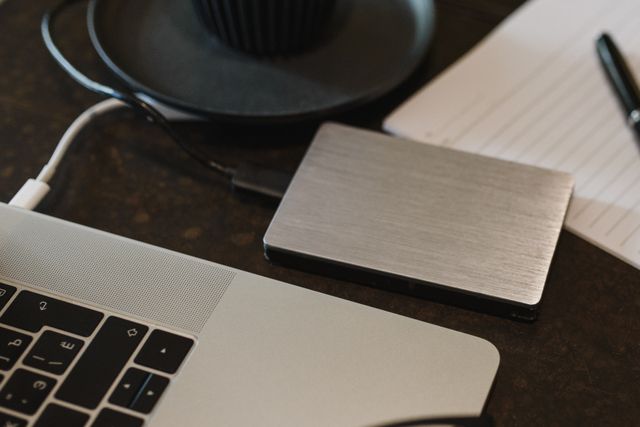
External Hard Drives: The Traditional Baseline
An external hard drive — whether a traditional HDD or a faster SSD — is a standalone storage device you connect to your computer, usually via USB, to copy and store files locally. It's the backup method most of us grew up with, and it's still a solid choice for certain jobs.
Key advantages
- One-time cost: no recurring subscription, you pay once for the hardware.
- Fast local transfer speeds: copying files doesn't depend on your internet connection.
- Full physical ownership: your data sits on a device you can hold, unplug, and lock away.
Key drawbacks
- Vulnerable to physical damage, theft, and loss: your only copy can be gone in seconds.
- No automatic background backup: if you forget, nothing gets saved.
- Limited capacity: once it's full, you're buying another drive.
- You are responsible for your security: there's no built-in encryption or redundancy unless you set it up yourself.
Best used for: offline archiving and editing large, uncompressed video files locally, where raw transfer speed matters more than off-site protection.
Koofr Tip: If you already own an external hard drive, don't throw it out — it's still the fastest way to work with huge local files. Just don't let it be your only copy. Pair it with an automated cloud backup so a single accident can't wipe out everything at once.
Cloud Backup: The Safe Option
Cloud backup works by automatically copying your files over the internet to remote servers managed by a storage provider, rather than to a physical device sitting on your desk. Once it's set up, your files are backed up continuously, without you having to remember to do anything.
Key advantages
- Protection against hardware failure and disasters: a fire, flood, or stolen laptop doesn't take your backup with it.
- Access files from smartphones, laptops, or tablets, anywhere with an internet connection.
- Automatic backup: once configured, it runs in the background.
- Possible to upgrade to larger storage whenever you need it, without buying new hardware.
- Security: reputable providers encrypt your files both in transit and at rest.
Key drawbacks
- Requires an internet connection to back up or restore files.
- Trust: you're relying on a provider to handle your data responsibly.
- Ongoing costs: most cloud storage is a recurring subscription.
Best used for: daily backups, remote work, and seamless access to your files across multiple devices.
Koofr Tip: Backup and sync aren't the same thing. Sync mirrors changes instantly — including accidental deletions — while true backup keeps recoverable snapshots. Read more in Cloud Synchronisation vs. Cloud Backup: What's the Difference?

Koofr Cloud Storage: The Best Alternative to an External Hard Drive
Koofr Cloud Storage is a European, GDPR-compliant cloud storage service built to solve the weak points of both external drives and generic cloud storage: single points of failure on one side, and vague privacy practices on the other. It's a secure, organised home for everything you'd otherwise trust to a single piece of hardware.
Why Koofr Cloud Storage wins
Superior privacy & security. Every file uploaded to Koofr is protected with server-side encryption by default. For anything more sensitive — passwords, ID documents, financial records — you can add an extra layer with Koofr Vault, which uses zero-knowledge encryption: your files are encrypted and decrypted entirely on your own device, so not even Koofr can read them. Combine that with two-factor authentication, including passkeys, and your account is protected well beyond what a password-only external drive can offer.
Cost efficiency. A decent 1 TB external drive costs somewhere around 70–80 eur upfront, but with an average hard drive lifespan of 3-5 years, you're likely buying a second (or third) one just to be safe. Koofr's 1 TB plan starts at roughly 8 eur a month, and subscription includes automated backup, off-site redundancy, and access from every device you own. With up to 50% Loyalty discount, Koofr is designed to be genuinely an affordable cloud storage.
User experience. Koofr automatically backs up photos and videos from your mobile phone, and can back up an entire computer using Duplicati. When you need to hand a file to someone else, sharing options let you send a secure link or add a collaborator directly, something no USB drive can do without physically changing hands.
Koofr Tip: You can also connect your existing Google Drive, Dropbox, or OneDrive accounts to Koofr and manage everything from a single dashboard. Switching to Koofr doesn't mean abandoning storage you already have.
External Hard Drive vs. Cloud Backup vs. Koofr: A Side-by-Side Comparison
1. Security & disaster recovery. A physical drive is a single point of failure — one mechanical fault, one fire, one theft, and it's gone for good. Koofr keeps your files on redundant servers, so a single piece of failed hardware never means a single lost file.
2. Accessibility & collaboration. An external drive means one device, one cable, one person at a time. Koofr gives you instant access from any device and lets you share a file or folder, whether the other person has a Koofr account or not.
3. Long-term cost & value. A drive's one-time cost looks cheaper on day one, but factor in replacements every 3–5 years and it starts to look a lot like a subscription anyway, just without the automation, redundancy, or accessibility. Koofr's scalable plans grow with you and never "wear out".
4. Setup & automation. Backing up to a drive means remembering to plug it in and copy files, every time. Koofr's automatic backup runs quietly in the background — set it up once, and it keeps working whether you remember it's there or not.
Final Verdict: Which Is Better for You?
There's no universal winner here, it depends on what you're doing with your files.
- Choose an external hard drive if you need raw offline speed for heavy local file processing, such as editing large video files, without relying on an internet connection.
- Choose Koofr cloud storage if you want automated, highly secure, scalable protection that keeps your files accessible and shareable anywhere.
- The hybrid approach: the two aren't mutually exclusive. Pairing a local drive with Koofr cloud storage is exactly the kind of layered protection you need: 3 copies of your data, on 2 different types of storage, with 1 copy kept off-site. A local drive covers the fast, offline copy; Koofr covers the off-site, automated one.
Koofr Tip: If ransomware or hardware failure is your main worry, redundancy matters more than raw speed. How Can You Protect Yourself Against Ransomware Attacks?

Frequently Asked Questions
Q: Is Koofr cloud storage safer than a physical hard drive?
A: Yes. Physical drives can crash, get damaged, or be stolen, taking your only copy of a file with them. Koofr keeps your data on encrypted, redundant servers, so it's never dependent on a single piece of hardware surviving.
Q: Isn't buying a one-time external hard drive cheaper than a Koofr cloud storage subscription?
A: It looks that way at first glance. An external drive has a lower upfront cost, but with an average lifespan of only 3–5 years, physical drives typically need replacing at least once over the same period a subscription would cover and each replacement carries a risk of losing data during the transition. A Koofr subscription spreads that cost out while adding automated backup and off-site protection the drive never offers on its own.
Q: How does Koofr Cloud Storage compare to buying a 2 TB external drive every few years?
A: Over several years, the running cost ends up broadly similar but a Koofr plan keeps working without you lifting a finger. There's no shopping for a replacement drive, no manually copying years of files across to a new one, and no gap in protection while you do it. Storage capacity can also be upgraded instantly, rather than requiring a new physical purchase each time you outgrow what you have.
Benefits of the Paid Koofr Accounts Besides Extra Storage Space
Conclusion: Pick the Right Backup for You
Both external hard drives and cloud backup are better than doing nothing but they solve different problems. A drive gives you fast, offline access to your files. Cloud backup gives you protection from the things a drive can't defend against: fire, theft, and its own eventual failure.
Stay safe. Backup your data with Koofr.
If you're still relying on a single external drive as your only copy, that's the gap worth closing first. Set up automatic backup with Koofr today, and keep the drive around for what it's still genuinely good at.
Want to talk to us? Join our growing Reddit community!
Editor's Note: This post was first published in 2017. We've updated and enhanced the content to improve clarity and detail. Whether you're revisiting or reading it for the first time, we hope this improved version offers an even better experience.